As you may be aware, if you are one of our regular clients we spend a lot of time in Italy, where we operate a cooperative for marginal rural areas. The last years were very full of coming and going, making it harder to find the time to update the blog, because when we are […]
As you may be aware, if you are one of our regular clients we spend a lot of time in Italy, where we operate a cooperative for marginal rural areas. The last years were very full of coming and going, making it harder to find the time to update the blog, because when we are back in Wales we are pedal to the metal with yurt covers usually. I will do my best to write more.
I have spent a lot of those last two years writing grants for various projects, to a point I was starting to be cast as a grant writer at times (something I detest). I have to admit though that writing EU Horizon grants was one of the most difficult things I ever done. I’ve written a grant for Heritage wheats all across Europe, trying to envisage a better future for rural farming, especially in marginal areas. It took four months. Bringing on 6-7 universities and joining them with some pioneers in the field of reintroduced heritage wheats was interesting, and I have developed a unique talent to bridge those two worlds, but it is the actual vision behind it all that talks to me most. Seeing what needs to take place, and then moving a million gears to make that happen, bringing players from all levels together, people who will never work with each other otherwise.
What grant writing has taught me is that there is a lack of vision in general, especially when it comes to rural planning. In the meantime, we also participated in a number of smaller grants, and through some weird coincidence, or maybe heavenly intervention if you want, we won two grants for experiential tourism, almost on the same day!, one in Italy from the Abruzzo region, and the other in Wales from Flintshire county council. Is someone trying to tell me something?
Like I always, I like to see events as map of sorts, and whilst I do feel like I am creating a new field of work, it is as if some force has brought me back to focus, back to tents (Yawn…)
I have written a lot about Glamping, and its role in the politics of rural areas for good and for bad, and also about nomadic structures, so I will not repeat all of that again. The task ahead is to tie those two grants together in some way, they represent two aspects of our life fields in which we are still pioneers if you want. The Welsh grant was for new machinery for tent making (a lot of it is welding equipment) and the Italian grant is for an equipment for medicinal herbs transformation and a laboratory. Tying them together and giving them an experiential tourism twist is also a little complicated; that is the problem with grants, you need to have a really clear vision of what you want to do before hand, and twist the grant towards it, because otherwise grants tend to turn your life around and you are running after the latest political invention or ecological greenwashing, and one day you wake up and you have become a Greta Thunberg for things you don’t believe in, or at least not enough to spend all your time on. Like I said the problem I that there is no vision for territorial rural planning, and that after 200 years of industrialisation the world has forgot a lot.
Now that rural design is becoming my new field of passion, I want apply the same logic to tent making. Imagine that we had to rethink tent design from the ground up, so much is wrong in tent architecture, and made worse by lousy industrialised processes, having worked with over 400 campsites, and endless private clients, you would not believe the tents that people bring to market. It is almost always the rule that the first yurt someone makes is of better quality then half of the stuff on the market, which is unique to this industry. In short as an industry we lost the passion for fabrication and invention of the best quality tents, or the import market has tired most involved beyond caring. I am looking into a new system feeling like I would like to explore tent making forms in a free hand way, after all we can cover any given shape with canvas, and so why limit the frames?
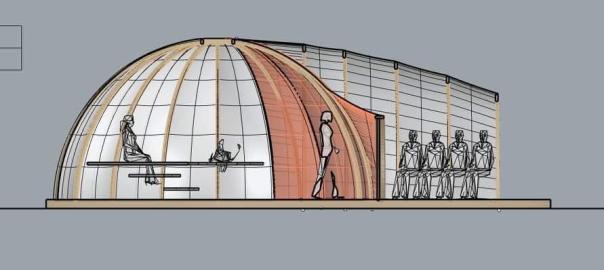
For the next step of this journey I have picked a sauna tent design I worked on with someone a few years ago, he wanted to create a tent for his Russian Banya business in the US. We got as far as coming up with a basic design, but took it no further, it joined the myriad of drawer dreams as Lidia calls them. My idea is to use the Russian Banya idea he introduced me to in some way that can use the medicinal herbs extracts from the Italian grant.
I am going to use the same metal bracket and curved beam construction we used before for the frame, use a felt liner for the internal structure and canvas for the outer, there is a problem with the sauna vapours and the canvas but lets leave that for now.
The idea of using the hydrolate (the byproduct from essential oil extraction) which is like a water with plant essence, came to us by mistake a year ago, when we were steaming yurt trellis. I was thinking about woodworm, and thought maybe if we put some essential oil in the steamer this would impregnate into the wood and could preserve it better by deterring bugs. Because we had bottles and bottles of Hydrolate left from distilling lavender with a woman we worked with in Italy, I thought maybe we can try and use that. Whilst it was in the steamer and opening the door to get the wood out I got an amazing vapour bath every time I opened it, this resulted in me fully immersing my head in the steam pipe for a few minutes, and believe me it was amazing!
So this is the plan, tying all the above elements together, new tent design to include curved metal and wood work, improved cover canvas work, new tent forms and shapes inspired by natural nomadic designs but breaking away form historic concepts that are no longer a parameter. And it ties toghether two different experiential tourism grants in order that they do not run me and instead I can use them to further our plans for rural areas regeneration in tandem. Like I tried to explain the problem with industrialisation is that people specialised in one given product, but without any connection to anything else, so everything is a little detached from everything else. Tents or shelters in general have become a little limited in that.
We would try to revive our newsletter for whoever wants to keep up with this journey (you can subscribe at the bottom of the home page) and progress. The idea is to inspire others too, to design better structures and higher quality tents, to bring manufacturing back to this side of the world. We call this programme Best in Tents, where once a year we pick a design and help someone realise it.